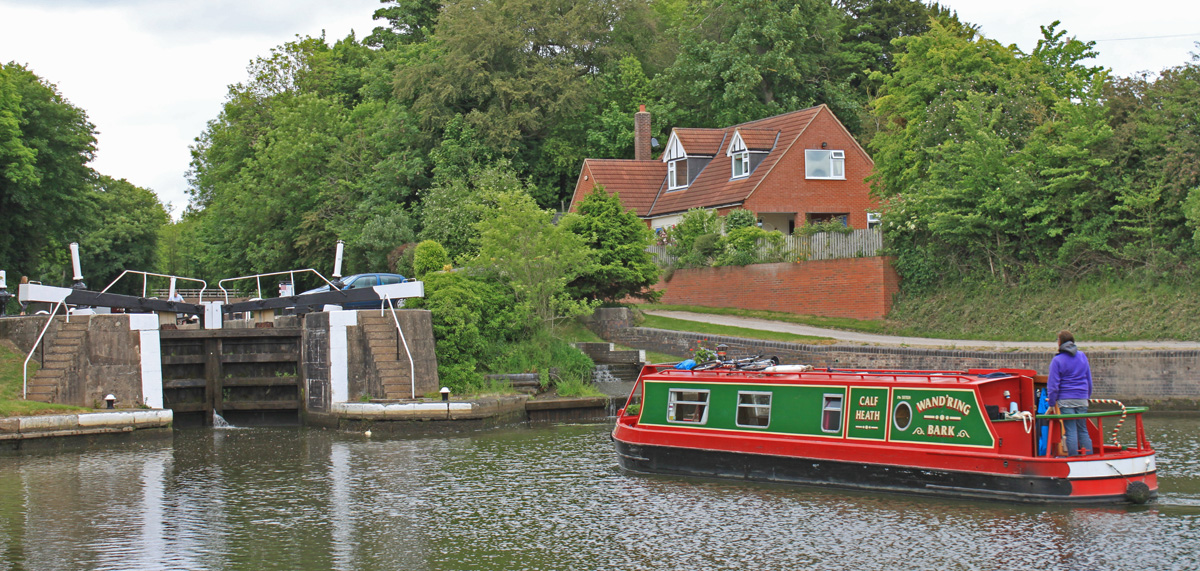
Sunday, 10 July 2011

Bread upon the Waters - book review

Bread upon the Waters
by David Blagrove


I am so indebted to Chris and Maralyn on nb Nebulea for introducing me to the works of David Blagrove. I arrived at Wand'ring Bark the other day to discover two of David's books carefully wrapped and ready to read. Its like my birthday every time I go there!


This book is unique in a number of ways, set as it is at the balancing point when commercial trade came to an effective end amid the ice and  snow of 1962 / 63, a decline spurred on by the indifference of the authorities and the structural shift from water to road.


There are other books from this period, books like 'Hold on a Minute' and 'The Last Number Ones' which record the latter days of narrowboat trading, but none which approach the subject with Blagrove's eloquence and eye for detail. Blagrove is a natural storyteller, a peoples person who appears universally well liked and able to draw illuminating first hand accounts from those he encounters.


But what of the book? 


Well, its an autobiographical account of a young Bragrove aged about 20 whose passion for narrowboats sat uncomfortably with his city office job. He ran a summer trip boat on the River  Kennet in Reading, and when he was sacked he expanded his passion for boating into full time winter work with Willow Wren. 


Willow Wren's contracts took him up and down the Grand Union, rubbing shoulders with the last of the working boatmen and their families, who accepted this enthusiastic young man into their community. By the time he plied the route between London, Birmingham and the Northamptonshire coalfields there were less than 100 pairs working the whole system, but he made the most of the meetings he had.  He listened to their stories and retells them in his book, woven into the tales of his own travels. 


The result is a book rich in atmosphere and history. I am sure that the technical descriptions are accurate, but its the people stories which bring it all to life. Its an age just after my birth and maybe six years before I started to travel the same waters, but not as one of his beloved boatmen but rather as part of a body tourist boaters who ultimately offered a new lease of life to a canal network, which appeared in terminal decline.


If you love the canals but want to get a real feel for how it was when working boats were for work and not for play, read on. 


The book was written in the mid 1980's and its sobering to realise that such is the passage of time that working boaters are passing out of living memory. David Blagroves account therefore represents one of the very last first hand accounts of this significant period, and is one to read and savour.


Read this book and you will emerge educated, amused and enriched - not bad for a book written 25 years ago.


Chris, Marlyn and especially David - thank you.

Friday, 8 July 2011

Stratford 2011 - Camp Hill to Tipton

Stratford 2011
Camp Hill to Tipton
21 May 2011

11 Miles - 28 Locks - 8 hours

Camp Hill moorings are as fine as they come in an urban area. Quiet, secure and with incredibly clean showers as a bonus. This is a great staging post for a full frontal assault on the BCN.

Birmingham New Main Line

Edu's Emigma was off before us, leaving me to turn the locks. Given the remoteness of the location this is one of the few places where I feel comfortable lock wheeling way ahead - right down to the bottom lock. But not everything went my way, far from it. As I puffed and panted my way back up beside the deserted pound my pedal fell off. Chinese bikes!

If that wasn't enough I got myself in a right muddle in the penultimate lock. Belle was off foraging and I was working solo. Because the pound below was low I decided to bow haul the boat out of the lock, but forgot that in doing so I would pull the boat onto an underwater shoal. Lo and behold my reward for a momentary lapse of sanity was a boat stranded about four feet out and way down below a brick retaining wall. In desperation I managed to flick the mop off the cabin roof and into my outstretched hands allowing me to push the bows out and get her moving just enough to leap aboard.

That troublesome tyre

Bad news tends to come  in threes and this was no exception. Belle had set the last lock but the top gate wasn't fully open. I urged her to get off the gate on which she was sitting and indicated my intention to give it a bit of a shove, squashing the rubbish behind. What I didn't realise was that behind that gate lurked a car wheel complete with hub and tyre. I gave it some welly and ground to a stop, stuck fast in the jaws, I couldn't go forward and I couldn't go back no matter how hard we revved or pulled.

Oldbury's tinny sculpture

Nerves turned to a cold sweat and thoughts turned to a BW rescue squad. Oh the embarrassment. In all my travels I have never, never ever resorted to calling in the troops. I mulled it over - the boat couldn't get narrower and the gate wouldn't open wider so the obstruction had to move. I tried it with a shaft and a mallet but that simply splintered my prize handspike. More thought - then a eureka  moment.. the tyre was inflated so a minute of two with a hacksaw on the carcass and the water erupted  if a flurry of pressurised air - and the boat drifted free.

Birmingham's BT Tower

Then it was up the Ashted flight in 45 mins before setting about the Farmers Bridge 13, passing an Anglo Welsh boat on the way down who promptly winded and did their up most to catch us up. With an empty gas tank and getting low on diesel I was pleased to see Away to Serve's service boat laying beside the National Sea Life Centre. This is a great facility in an area with very limited service options. As we took on diesel Belle produced a steaming bowl of nettle soup, made from fresh nettles picked from Camp Hill Locks accompanied by home made bread. All very tasty, winning the approval of a sceptical Away engineer.

Nettle picking in Digbeth

Our passage to Tipton included the loops and the Old Main Line via Smethwick- always our preferred route across the Birmingham plateau. Its really good to see the toll office at the top of the Smethwick flight all fixed up. Lets hope that the new roof is both secure and fireproof.  

Smethwick's refubished toll house (again)

The Old Main Line offered loads of scope for foraging for Japanese Rose, today's target plant. All this stop and start through the lillypads was a bit of a nightmare and resulted in several trips down the weed hatch.

Foraging for Japanese Rose at Oldbury

We used the Black Country Museum as a mooring, squeezing in among a plethora of workboats which were using most of the space before making a pilgrimage to Mad O'Rurkes, home of the splendid Black Country Lumphammer.

Wednesday, 6 July 2011

Stratford 2011 - Chessetts Wood to Camp Hill

Stratford 2011
Chessetts Wood to Camp Hill
20th May 2011


14 miles - 5 locks - 7 hours


The morning started by retracing our steps back to Kingswood Junction. It would appear that the widened Grand Union had a standard width of 40ft, 2 ft narrower than Wand'ring Bark's 42.5 ft, nearly wide enough to wind, but not quite. Oh well, at least the little diversion meant that Belle had some hot water for a shower.


National Trusts Baddasley Clinton


The entrance to the National Trust's Bad-ass-ley Clinton is about half a mile from bridge 66, but then there is the long tree lined drive which winds on for nearly a mile before you arrive at this classic moated house. We have visited before and whilst the house is nice enough it's the garden we had come to see. The early summer flowers were in bloom, surrounding the house set amid its glittering moat. Well worth a £6.50 charge.


Clock Tower at Baddasley Clinton


We returned to the boat for 1.00pm aiming for a night at Camp Hill, close in to the city centre. This is the "middle road" into Birmingham, part of the 1930's improvements to link Birmingham with London, with enlarged locks and bridge holes. But it was an initiative which failed to deliver the  goods. This scheme did leave a legacy of new locks, and none more impressive than the five at Knowle which replaces six narrow ones whose chambers have been converted into weirs.


Knowle Locks

The canal is pretty enough to Catherine de Barnes at which point it slips over the watershed, one side sending a trickle of water to the Atlantic via the Severn and on the other the droplets heading north via the Trent basin into the distant North Sea. The canal then enters tree lined cuttings which prompted Belle to comment on its attractiveness. This is true but after three hours the same scene starts to wear a bit thin. Its not surprising this rubbish strewn route is the least popular route into the city.


Bordesley Green - Gateway to Birmingham

I last came this way two years ago and noticed the quality mooring at the top of the Camp Hill Locks. Given the remote location I expected to see only a couple of BW workboats but as we approached we spied Edu's Enigma moored across the tap. Like us, they never expected to see another boat and quite reasonably used the tap mooring. We came alongside and refilled before reversing back into the one remaining arm and hunkering down behind the very snazzy service block, the quiet only disturbed by the distant rumble of trains running over the adjacent viaduct.

Camp Hill moorings

If you ever find yourself in this neck of the woods I can vouch for the mooring, and if my word isn't enough, the absence of anti vandal locks on the Camp Hill flight bears testimony to a better than normal area.

Monday, 4 July 2011

Stratford 2011- Wilmcote to Chessetts Wood

Stratford 2011
Wilmcote to Chessetts Wood
19th May 2011


14 Miles - 18 Locks - 8 Hours


Ah, holidays! Instead of me contacting Jeff whilst I am on a Pendelino heading for Euston, he wakes us up with his routine 9.00am call on his way to college. We make rattly clanking noises but he isn't fooled  - he has caught us napping in bed and making a lazy start to the day.


A relaxed Captain


The reason we stopped at Wilmcote, apart from the rain, was to see Mary Arden's house which opens at 10.00am daily (price £9.00). The Shakespeare Birthplace Trust don't make a lot of the house itself but they have created an Elizabethan Farm complete with characters in costume going about their business. Given her foraging interest, Belle was particularly taken with the organic garden full of old herbs and plants destined for the dining table.


Mary Arden's Cottage

Elizabethan Haystack

We were off at noon, drifting up the long central pound without a care in the world - perfect shorts and tee shirt weather with barely another craft on the move. One of the few boats were the Oak and Ash combo, working their way down to Stratford with a complete compliment of customers. As is so often the case, we passed a few familiar boats with whom we had been playing leapfrog for the last few days, but these were moored up at Yarningale. The South Stratford has gone to sleep.

Oak and Ash

We pressed on through the locks, some for and some against as if in a dream. Maybe those two pints of homebrew were stronger than I thought! We became more and more laid back as the afternoon wore on, passing Sarah and the Book Barge at the Fleur De Leys where she had given up the water in favour of a few days of home comforts. 

Barrel roofed cottage on the Stratford Canal

Along the way some cheeky ducks landed on the roof, an appearance which Belle encouraged with some suitable cooking arrangements.


We made it to Kingwood Junction at 6.30pm and then struck out up the Grand Union for bridge 67 to be near Baddesley Clinton for a visit in the morning. When we arrived I had a moment of realisation. Baddesley Clinton is near bridge 66, a mile back down the canal. Belle is unwell and in no state to to walk the extra two miles so it was on to the winding hole at the Black Boys and then back the two miles to Bridge 66. I guess I will be returning to Kingswood tomorrow morning to wind again - I am getting to know this stretch very well.

Saturday, 2 July 2011

Factoids from the BCN

Factoids from the BCN
2 July 2011

First off: What is a factoid? Well, there are a few different definitions. One school of thought says this its something presented as a fact but in fact isn't - like a humanoid isn't quite Human. The other definition, which I prefer, is a fact which is trivial and of no real consequence - the definition which Steve Wright appears to have adopted.

Maybe this is best summed up in "Common errors in English Usage":

The “-oid” ending in English is normally added to a word to indicate that an item is not the real thing. A humanoid is not quite human. Originally “factoid” was an ironic term indicating that the “fact” being offered was not actually factual. However, CNN and other sources have taken to treating the “-oid” as if it were a mere diminutive, and using the term to mean “trivial but true fact.” As a result, the definition of “factoid” ishopelessly confused and it’s probably better to avoid using the term altogether.


I guess that this introduction is a factoid itself - but back to the point of this post.

I have been reading Bread Upon the Waters by David Blagrove, kindly lent to me by Chris and Maralyn of nb Nebulae who are aware of my passion for old waterways books.

I will post a proper book review when I finish the second half but as I read the account of their 1961 trip through Birmingham I chanced upon some nuggets of fact, or possibly oft repeated assertions which have grown to be accepted as fact. Whatever their provenance, they struck a chord with me and justified a post so I have somewhere to refer back to as my memory fails (further!).

I will take this factoids on the order they appear (pages 92 to 94).

1. The BW depot at Sampson Rd Bordesley , aka Camp Hill. This was built by the Grand Union in the 1930's as an inland port and the terminus of their widened Birmingham to London waterways route. As Blagrove puts it "it was an act of faith which should have been well rewarded". In the event it never realised its potential and even in 1961 "one of the loading bays had already been walled up". By an interesting synergistic  twist the site is now home to some of the finest BW facilities anywhere in the country - but hugely underused. They were funded by a development projec which never happened and are therefore an endowed benefit on this city centre location. Another act of faith which failed  to be rewarded. But do use the site, its safe and boasts better facils than the more popular Black Country Museum on the other side of the BCN.

2. This account predates my own first memories of the BCN by about 7 years, but given the trajectory he describes, the state of the BCN I recall is very consistent with his account. I vividly remember a flight of locks which were a sea of oil and grease. Oil covered the canal with a thick black  slick and the lock margins were a veritable skid pan. I have always struggled to place these locks, but I had narrowed it down to Garrison or Ashted. This book describes the utter filth he found on the 1840 Brimingham and Grand Junction Canal, later part of the Grand Union but generally known as the Saltley Cut.  Blagrove's description cant be bettered:

... the flight of five locks was the filthiest piece of canal I had yet encountered, bar none. Grease oozed blackly from the lock chambers as we dropped. A sort of foul black patina settled on the brass paintwork...

The Capt Snr always referred to them as "Oily Locks" - and until recently I had assumed this to be their given name. I suspect I have finally identified the true location of "Oily Locks".

3. The name Camp Hill has excited my curiosity on more than one occasion, as has the name Garrison Locks with no sign of a local Army presence. It appears that Camp Hill was given its name as the location where Prince Rupert set up camp during the Civil War.  Garrison Locks are lent their name due to the practice of stationing troops in the area till 1830 when a local police force was set up - 10 years before the canal was built.  Both explanations work for me.

4. The Saltley cut formed part of the boaters route from the Cannock Coalfields down to the customers in the south. This route included five sets of narrow locks, Daw End, Rushall,  Perry Barr and the Garrison / Camp Hill  flights combined which where hung together in the following jingle:

"Moshes, two and the Ganzies seven.
The New Thirteen and the l'ousy leven"

Blagrove has plenty more to say about the area in the early 1960's but that's enough for now. A few tantalising nuggets to be scattered like seasoning on a good roast next time you are chewing the BCN cud with fellow boaters.