Showing posts with label Aire and Calder. Show all posts

Thursday, 28 June 2018

On to the New Junction Canal

Leeds to Sykehouse Junction
June 2018

Here we are again, playing catch up with the blog posts having spent four days on the move.

Reflecting on Leeds mooring

We left a very cosmopolitan Leeds Waterfront behind us and immediately were out onto the Aire and Calder Navigation with its broad waterways and mechanised locks. This is a waterway on a completely different scale and it wasn't long ago that it was used commercially to bring oil to a depot in Leeds. The storage tanks remain in service but the tankers are long gone.

 Leeds bridge and Lemonroyd Lock

Leeds waterfront

The navigation also carried huge quantities of coal and the entire landscape is sculpted by reclaimed spoil tips and the canal fringes dotted with silted wharfs and reedy inlets.
As with most of these northern canals, we pretty much had the place to ourselves all the way through to Castleford, our destination for Monday night. Here we restocked at a supermarket but the endless days of wall to wall sunshine make dragging a shopping trolley anything but a pleasure. 


Tuesday was a day to clock off the miles, nearly 18 all told which is a long day for us. We refilled the diesel tank at Supreme Marine, putting in 120 litres which was the first refill since the outskirts of Liverpool three weeks ago. The diesel was pricey but we really needed it before the Trent so the took the cost on the chin.

Silting on the Aire and Calder

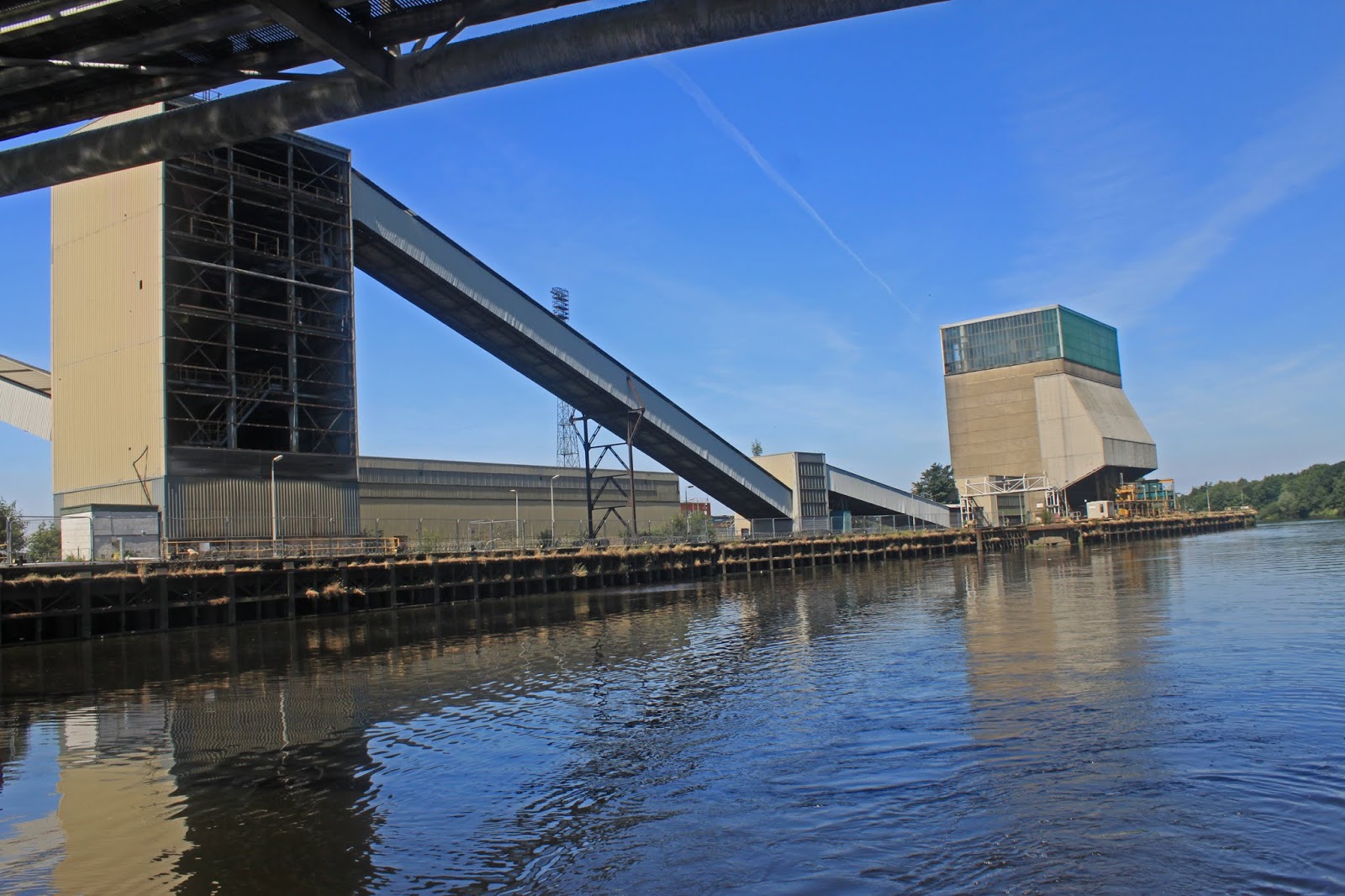
If the navigation to Leeds was big, the waterway now reaches incredible proportions, built to accommodate the trains of Tom Puddings which moved coal from the many pits to Castleford Power Station and Goole. Today the power station unloading machinery stands idle and a forgotten relic, covering beneath the huge cooling towers. 


Industrial relics at Castleford

Not far beyond Knottingley stands the site of Kellingley Colliery, the last UK deep pit to close. Last time we came past, maybe 5 or 6 years ago the colliery was still working but today the pit head gear stands forlornly among the heaps of spoil, which are gradually being landscaped. One odd twist is that the site of the colliery is now home to an enormous solar array, which must be kicking a lot of power into the grid on sunny days like these. Old school meets green renewables.


The past and the future in the same image

Then it is out onto the flat lands where the ultra wide canals stretch on for mile after mile without the slightest deviation. Fast and effective but just a tad boring!

Signals looking very steam punk

By now we are in the land on mega locks where even the short version of the chambers would hold 20 narrowboats and is used to their maximum extent the number would rise to 100 or more. Our little pair look a bit absurd bobbing around in a cavernous chamber.

Sharing the space with the big boys at Sykehouse Junction

We moored in a patch of shade at Skyehouse Junction and before long a huge tanker bound for Rotherham rumbled its way past, built to fit the dimension of the locks. Its great to see real life commercial activity on the South Yourkshire Waterways, but I suspect its keel wasn't far off  the canal bed. Its passing stirred up the silt leaving a pungent aroma in its wake.

Tuesday, 24 September 2013

Rochdale 2013 - Stanley Ferry

Rochdale 2013
Ferrybridge to Stanley Ferry
30th September 2013

10 miles – 4 locks – 5 hours

More lazy days – but we are on holiday. We wake, make coffee and then lay there in bed with the back doors open and the sun streams in – isn’t this what boating is all about?

Ferrybridge moorings

Our trip now starts to mix fiver with canal, sweeping past the huge Ferrybridge power station with is mothballed jetties and hoppers, the metalwork rusting and the concrete crumbling. It’s hard to image that just a couple of decades ago millions of tons of local coal was moved to the power station by a succession of boats.

Ferrybridge - abandoned coal hoppers

But is not that the power station does not need coal – it needs loads of the stuff. The fact is that most of the local collieries have closed down and all we are left with are hundreds of flash lakes caused by subsiding mine workings. All the tailings tower over the area but these are being landscaped and the navigation north of Castelford is now reminiscent of the River Severn, with mature trees reaching down to the waters margin. The only clue to the areas heavy industry history is the strata of waste in the river banks and the occasional incongruous pipe sticking out into the river channel.

River Calder

We stopped at Castleford, a place we missed on out trip to the Huddersfield Canal a couple of years ago.  The moorings are both good and plentiful with water, waste and pump out available – not that we need the pump out these days. Beware – the pump out only runs for 7 mins which meant that the widebeam we had been shadowing needed two cards to empty its tank.

Castleford Flood Lock


We moored by the flood lock and were advised to follow the footpath round by the river to the footbridge into town.  This was a pleasant walk, but be warned that it is at least 15 to 20 mins walk to reach the shops. Castleford is no great shakes if the truth be told – there are a couple of supermarkets but they are at the far end of town and this meant that I refused to carry more than 10kg’s of sugar on my rucksack – it seems reasonable to me! The big positive about the place is the Millennium footbridge which crosses the weir and carries you to one of the few operational flour mills in the area.  The weir comes complete with an abandoned barge which has seemingly gone over the top and become embedded itself in the masonry. To my eye it’s all a bit Disney and contrived, but no doubt I will be advised that it is entirely genuine and happened during a huge flood in such and such year.


Castleford

What the town lacked in quality it made up for in blackberries. The hedgerows by the allotments were heavy with them and we returned clutching carrier bags containing another 4kg’s of fruit destined for the jam jar.

Stanley Ferry flood lock 


We could have stayed at Castleford for the night, but we decided we wanted a pub meal so set off for Stanley Ferry this time avoiding the gravel bar at Fairies Lock (we got stuck last time). The pub at Stanley Ferry is big and a bland family eatery but the food was good, hot and reasonable and whilst the choice of beer was not wide, they did offer Old Speckled Hen which was most acceptable.

Sunday, 22 September 2013

Rochdale 2013 - Ferrybridge

Rochdale 2013
South Bramwith to Ferrybridge
29th August 2013

17 miles – 3 locks – 7 hours

Another lazy start at 11.00am, delaying departure as we completed a long lists of jobs which needing attending to around the boat, including a sign for the front of the boat advertising the sale of our preserves.

Bramwith Lock

Foraging opportunities came thick and fast, with a big crop of blackberries available on the junction with the New Junction Canal – that relatively new cut with it’s dead straight line punctuated only by a succession of lift bridges and one huge lock.

Previous travel along this canal had led us to a particularly productive abandoned orchard which we revisited and picked kilos and kilos of apples supplemented by three kilos of blackberries. Fortunately this spot was free of wasps, insects which plagued us all the way down the canal and saw the executioner in regular use in spite of the closed windows and doors. They were everywhere!  Unusually, the area was also riddled with mint, too old to use but presumably left over from someone’s garden. The mint gave off lovely waves of fragrance as I bashed my way through the brambles to reach the best blackberries.

Don Aqueduct - New Junction Canal

After picking for an hour or so a little convoy of boats came past with a bloke on a bike riding down the towpath setting all the bridges. These bridges are a real pain so we cast off in undignified haste and caught the procession up sailing majestically through all the obstructions whilst Helen made jam in the galley.

The Aire and Calder is the big daddy of the waterways hereabouts – built for huge commercial craft but sadly all the trade has gone with the last aggregate contract running out this year. We are left with a jumbo sized network which has an air of melancholy about it – more so that the Midlands canals which have been reclaimed as the preserve of the leisure boater. We tailed a couple of local boater to Pollington Lock where we hit a snag. The electronics failed and we couldn’t operate the lock. We tried everything but it was dead, so we resorted to calling Canals and Rivers who sent a guy out and he overrode the boater operation panels and managed us through from the control room.

Convoy down the New Junction Canal

Pears had been on Helen's daily want list and I finally found a tree, just outside Killingley Colliery. They were as hard as bullets and not that many of them but one does not look a gift horse in the mouth...


We now needed to moor but Knottingley offered few attractive options, so instead we moved on to Ferrybridge and its visitor moorings which are unpleasantly close to the A1, but are at least secure.

Saturday, 10 September 2011

Huddersfield Ring 2011 - Pollington to Wakefield

Huddersfield Ring
Pollington to Wakefield
6th August 2011


28 miles - 11 locks - 10 hours

The start of the day was a blast. Well actually the day started with a blast from the horn from a huge bulk carrier which was making its way down the New Junction Canal and on to Goole. It certainly made us jump and had me out of our bunk and scrabbling for my camera. Who says there and no large commercial craft left?


The 9 miles of the Aire and Calder to Knottingley are pretty uninteresting, broad, deep, with high steel piled banks which stretch on for mile after mile. A true motorway of canals, fast, efficient and dull.

What few locks you encounter are huge, long chambers stretching away into the distance. Fortunately, the locks are sub divided and leisure boats can use a short section at the bottom end with the gates and paddles controlled by hydraulics. You get a feeling of power pressing that button and seeing the giant indicators rise and the ground paddles wind up in their hidden recesses.


Pollington Lock

There is relief from all this lowland flatness after the M62 when you approach your first hill since Nottingham, but closer inspection reveals that this 300ft rise is not part of the Pennines . In fact its the reclaimed tailings from the local coal mines now forested over. Then its past Kellingley Colliery, one of the few remaining deep mines in the country. Not that the coat is being moved by water, that finished years ago. Now all the coal is moved on an endless chain of Heavy Haul railway waggons.


Kellingley Colliery

Knottingley brings some relief from all this industry with its corn mills its canal side ampitheatre, its gypsy camp at the junction and then, at the far end, there is the vast bulk of Ferrybridge Power Station with its huge cooling towers standing tall, sending clouds of steam high into the sky. 

Travellers at Castleford

This power station used to be supplied by 24 local pits, with at least 25% of its coal delivered by water.

Ferrybridge Power Station

There follows four miles of winding river, quite pretty but spoilt by the the very visible tailings which line its route. There are several old colliery loading basins along this section which are navigable and would make an interesting overnight mooring. I'm glad to say that the scars of mining are healing and within a few years the ravages left behind will have largely disappeared.

Battlestone


From Castleford the land starts to roll, the first indications of the Pennines up ahead. Beyond this lies Stanley Ferry with its pair of aqueducts, our planned destination. However, the stony cill would have made for a bumpy night so we pressed on through Fall Ing Lock, the start of the Calder and Hebble and an end to the electrically operated gates. But before we got there we hit a snag at old Fairies Lock where we ran ourselves hard aground on a shingle bank opposite Lefarge's winding hole. No sooner had we got stuck than nb Magrathea appeared and snatched us off - we barely had time to say thanks before they were off round a bend in the river. 


We passed Wakefield and found the place rather underwhelming. The town sits back away from canal and whilst there are some good warehouses there was little to make us stay. The Calder and Hebble comes as a refreshing change after the massive Aire and Calder - a navigation on a human scale. Its locks reduce to sub 60ft and are about 16ft wide, many replacing smaller earlier versions which still stand to one side, themselves lengthened at some point in the Navigation's history.


We re watered at Broad Cut Low Lock and moored in the cut above Broad Cut Top Lock, away from the roar of the motorway but still close to a branch railway which crossed the valley on a viaduct high above us. 


This is a very peaceful area with the once navigable River Calder winding away behind us, the intimacy of the canals is gathering us once more into is embrace.


Back to index.