Wednesday, 13 November 2019

The Avery Loop - Main Line

The Avery Loop / Soho Foundry - Main Line


I have never been entirely sure what to call the last lost loop just before Smethwick Junction. For the sake of a better name I have always referred to it as the Avery Loop, a loop of canal created by the construction of the New Mainline Canal which looped round the old Avery Works, a contemporary of Matthew Bolton's Soho Manufactory


The northern entrance bridge reads into a basin dug by Avery's in 1936 and is at a slight angle outside the original line of the loop canal.

The complete line of the loop in 1937

Soho Foundry with basin covering Avery Loop - Keith Hodgkins


Immediately opposite, near Rabone Lane there is another blocked up canal arch which is framed by yet another rise and fall in the towpath and backed by modern factory building on Steelbright Road.
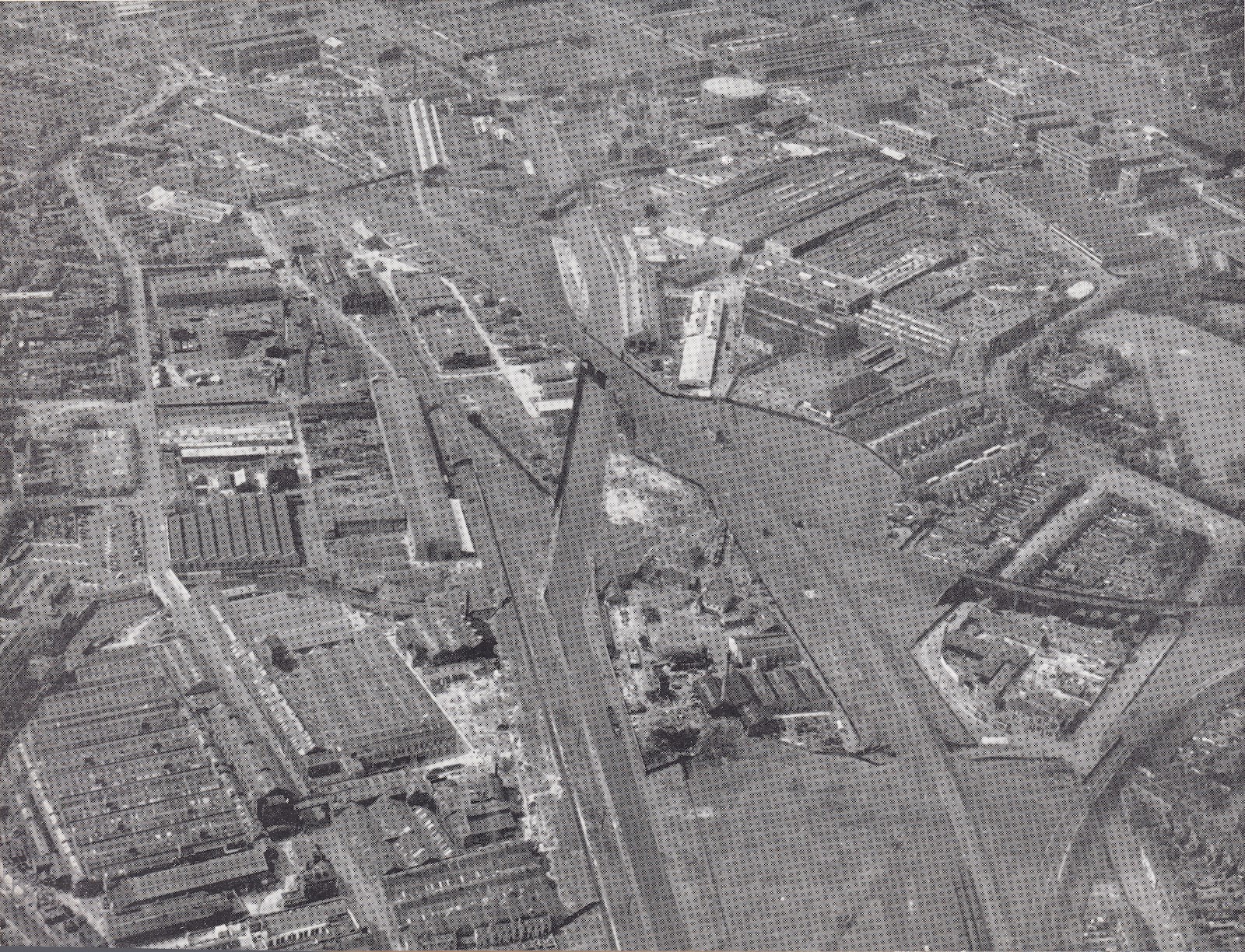


1974 View from near Rabone Lane towards the Avery Arm (Hugh Potter)

Entrance to Avery Loop south 1973 Hugh Potter

Northern entrance to Avery Loop 1973 - Hugh Potter

Avery Loop northern end at Soho Foundry 1890 - Birmingham Archive

Another version of the same photo - which one is undoctored? Source Laurence Hogg Collection


The Soho Foundry Wharf - Keith Hodgkins


1936 as the Soho Foundry Basin was filled in - Keith Hodgkins

Among Hugh Potter's photos of the area taken in the early 1970's, there is one image taken from behind the wall and looking across the canal towards the site if the Avery Works and the site of the Soho Foundary, with the distinctive chimney and stepped wall still visible.


The southern entrance in 1937 (foreground)


Just to the north of the Avery Loop is Rabone Bridge and the start of the lost Rabones Loop, accessing the Cornwall Works. This was another shallow loop to the east of the mainline canal which is now completely built, over but even in the mid 20th century it remained navigable and was referred to by the boatmen as "Tangy's Hole" accessing the works of Walton and Browns. This loop had no towpath and the old coal boats had to be shafted in and out by hand, and the coal shovelled over a wall into the works yard.


Cornwall Works Arm 1930's


Click here to return to the Birmingham to Smethwick area index page


The above


Monday, 11 November 2019

Sandwell Coal Chutes

Sandwell Coal Chutes

There is a missing landmark on the Old Mainline in Smethwick, a bit like a missing tooth in a familiar smile.


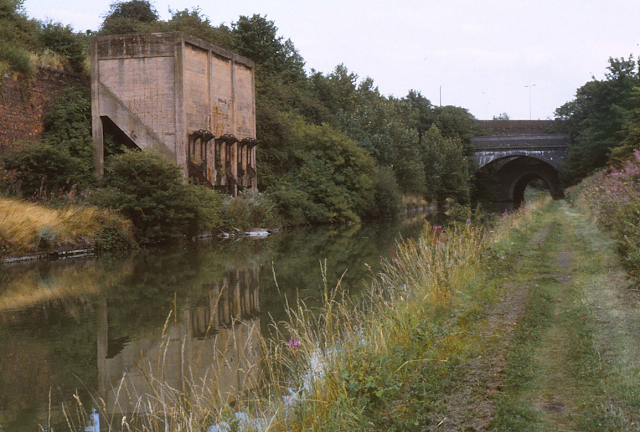
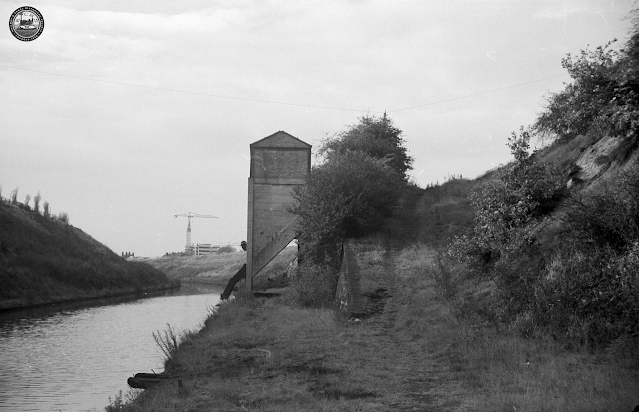
The landmark I am talking about is the set of canal-side Coal Chutes which were built to transfer coal mines at the nearby Sandwell Park Colliery. This coal arrived by tramway and was dropped into BCN day boats (Joeys) waiting below.


BCNS Archive


These loading chutes towered over the Old Main Line, gradually decaying following the closure of the colliery at the far end of the tramway. Over the years the concrete towers crumbled and ended up in a dangerous condition before they were finally demolished and replaced with an interpretation board.

 An images has emerged from the Hugh Potter collection which provide a great insight into this landmark as it was in 1974, before the decay really set in - another little bit of the BCN's rich jigsaw.

1964 - RCHS Ian Huselbee


Two1964 images by Ian Huselbee (RCHS)

Coopers Coal Wharf in Smethwick - BCNS Archive


Click here to return to the Birmingham to Smethwick index page

The above photos have been assembled from various sources, including those freely found on the internet. My thanks go to the many photographers alive and dead who have contributed to this collection and in so doing, are keeping the memory of these lost canals alive. These images are reproduced for ease of research are are not necessarily the property of this blog, and as such should not be used for commercial gain without the explicit permission of the owner (whoever that may be).

Saturday, 9 November 2019

An un-regenerated Engine Arm, BCN

Engine Arm as it was
November 2019

The Engine Arm in Smethwick has been a backwater full of residential boats for decades, but back in 1974 it was all very different. 

Among the Hugh Potter collection of black and white images there are two which reveal this as the abandoned backwater as it used to be. This was back in the day when there was no winding hole at the far end and an expedition along this obscure arm resulted in an awkward and rather long reverse back out again.


If you are unfamiliar with the Engine Arm you may wonder why the BCN went to the bother of erecting such an impressive aqueduct to go....well, nowhere in particular. Truth be told the Engine Arm's has always out-punched its weight, not only serving the various canal side factories but it was also a key feeder for the Wolverhampton Level above Smethwick Locks.


Not only did it receive water from the Titford Pools Reservoir via the Tat Bank Branch, it was also home to a large pumping engine which lifted and recirculated water from the Birmingham Level below.


So that accounts for the need for an aqueduct over the New Main Line, but why so fancy? To be honest I don't really know. It was cast by the rapidly expanding Horsley Iron Works in nearby Tipton, and its my personal belief that the simple metal trough was embellished just to show what they were capable of.

Engine Arm Aqueduct in1974

As usual, if you know differently, leave a comment below.

Thursday, 7 November 2019

Chance's Basin

Chance's Basin 


It's not every day that I come across an old photo of something completely new to me on the BCN.

Trawling through Hugh Potter's black and white images from the 1970's, I chanced (pun intended) upon two photos of a basin hidden behind an ancient guillotine gate, a basin I have never seen recorded elsewhere.

The narrative tells me it is a basin which went into Chance's glassworks in Smethwick and with a bit of help from Paul Balmer, this is its location:


Here are the two photos which capture the relic in March 1975:


Guillotine Gate - Hugh Potter 1973


A 
The red arrow is the shed before the roof was removed and the green arrow is the entrance.


This is the basin behind the green arrow taken in 1966 by Martin Leech, after the shed had been removed

For a contemporary context, the entrance used to be on the Smethwick side of Stewards Aqueduct and looks like this:


My thanks to Paul for his assistance in accurately placing these archive photos.

Click here to return to the Birmingham to Smethwick index page

The above photos have been assembled from various sources, including those freely found on the internet. My thanks go to the many photographers alive and dead who have contributed to this collection and in so doing, are keeping the memory of these lost canals alive. These images are reproduced for ease of research are are not necessarily the property of this blog, and as such should not be used for commercial gain without the explicit permission of the owner (whoever that may be).

Tuesday, 5 November 2019

Ryders Green Interchange Basins

Ryders Green Interchange Basins
November 2019

Those of you familiar with the BCN will be aware of the large number of railway interchange basins which are dotted around the local canal network.


By the time the railways arrived there was simply no spare space to fit railway tracks into the established canal based infrastructure, and a pragmatic approach was taken instead. Railways were brought in where possible and the loads were then transferred to canal boats for shipment to their final destination. This approach had the added benefit of temporary storage pending unloading.


One of the largest interchange basins exists at the foot of the Ryders Green Locks, but its all so overgrown that it's hard to imagine what it used to look like.


Well perhaps I can help there. Hugh Potter's photos from 1974 include a number of the interchange basins viewed from the bottom lock.


Ian Huselbee 1966

Interchange Basin taken by Bob May (BCNS Archive)

1979 - Trevor Littlewood


Ryders Green Locks scene from the BCNS Archive

Ryders Green Locks RCHS collection


Ocker Hill Power Station 1979


The above photos have been assembled from various sources, including those freely found on the internet. My thanks go to the many photographers alive and dead who have contributed to this collection and in so doing, are keeping the memory of these lost canals alive. These images are reproduced for ease of research are are not necessarily the property of this blog, and as such should not be used for commercial gain without the explicit permission of the owner (whoever that may be).